
What Is AI Automation? A Beginner’s Guide for 2026.
If you’ve been wondering what is AI automation, you’re not alone. Business owners, freelancers and entrepreneurs are searching for ways to save time, reduce manual work and improve productivity. As a result, AI-powered automation has become one of the fastest-growing business trends in recent years.
However, many people hear the term without fully understanding how it works or how it can help their business. The good news is that AI automation is easier to understand than most people think.
In this guide, you’ll learn what AI automation is, how it works, where businesses use it and how beginners can start implementing automation systems that save time and increase efficiency.
What Is AI Automation?
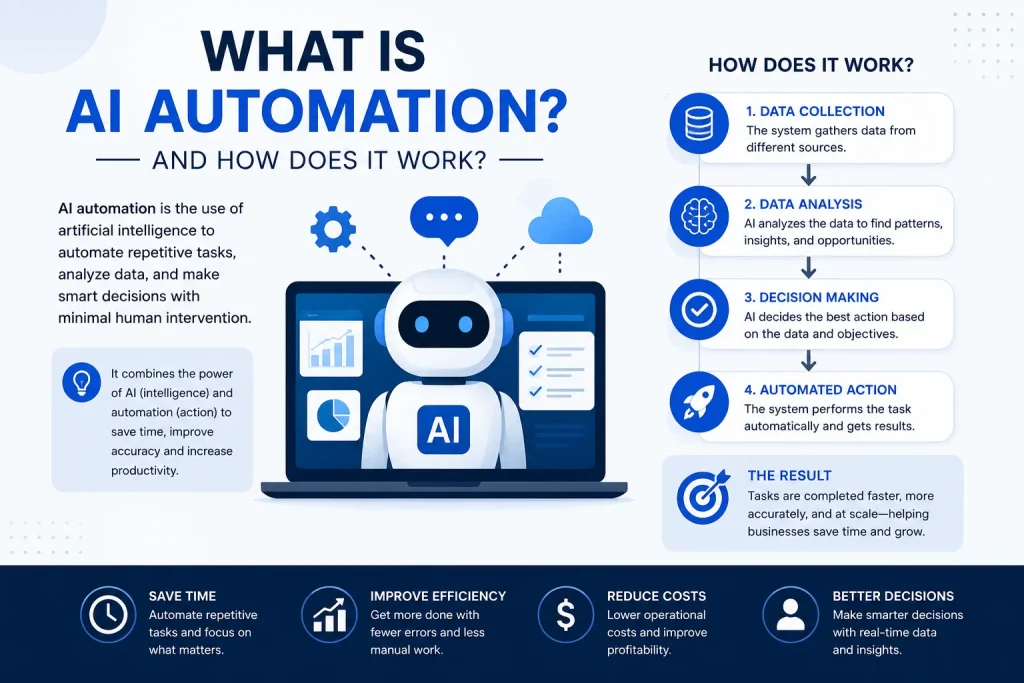
AI automation combines artificial intelligence with automated workflows to complete tasks with minimal human involvement.
Traditional automation follows fixed rules. In contrast, intelligent automation can analyse information, identify patterns and make decisions based on data.
For example, a traditional email workflow may send the same response to every customer. An AI-powered workflow can analyse customer behaviour, personalise responses and determine the best action automatically.
As a result, businesses can improve efficiency while providing a better customer experience.
OpenAI has helped drive significant advances in artificial intelligence, making AI tools more accessible to businesses and individuals around the world.
How Does AI Automation Work?
Most automation systems follow a simple process.
AI Automation and Data Collection.
First, the system gathers information from different sources.
This may include:
- Website activity
- Customer enquiries
- Emails
- Sales records
- CRM systems
Data Analysis.
Next, artificial intelligence analyses the information.
It identifies patterns and trends that help businesses make better decisions.
Consequently, organisations can react more quickly to customer needs and market changes.
AI Automation and Decision Making.
The system then determines the most appropriate action.
For example, it may:
- Prioritise leads
- Categorise enquiries
- Recommend products
- Trigger workflows
Automated Action.
Finally, the software completes the task automatically.
Therefore, businesses save time while reducing repetitive work.
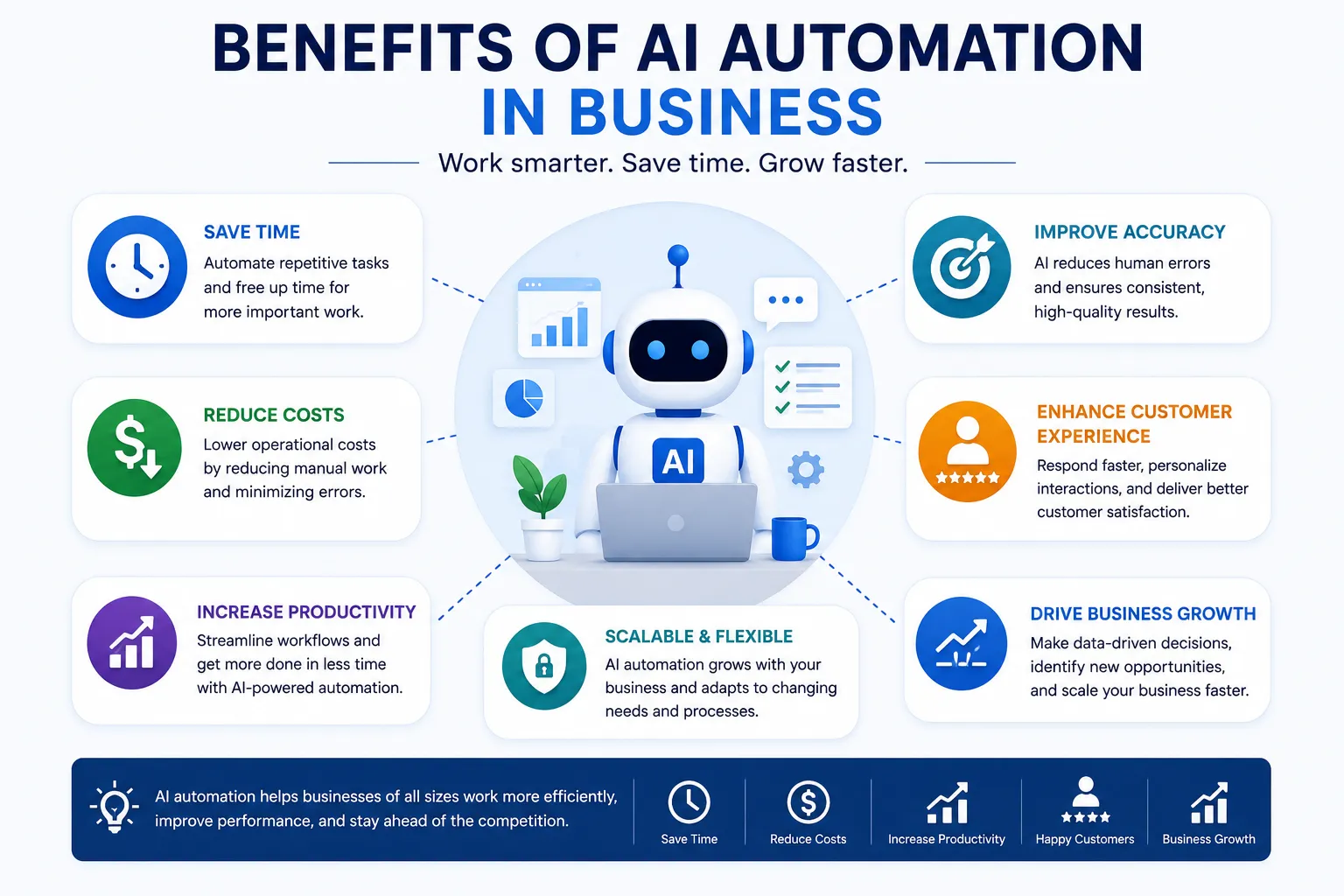
Benefits of AI Automation for Modern Businesses.
Businesses adopt automation because it delivers measurable benefits.
Save Time.
Many employees spend hours every week on repetitive tasks.
However, automation tools can complete those tasks within seconds.
As a result, teams can focus on more valuable activities.
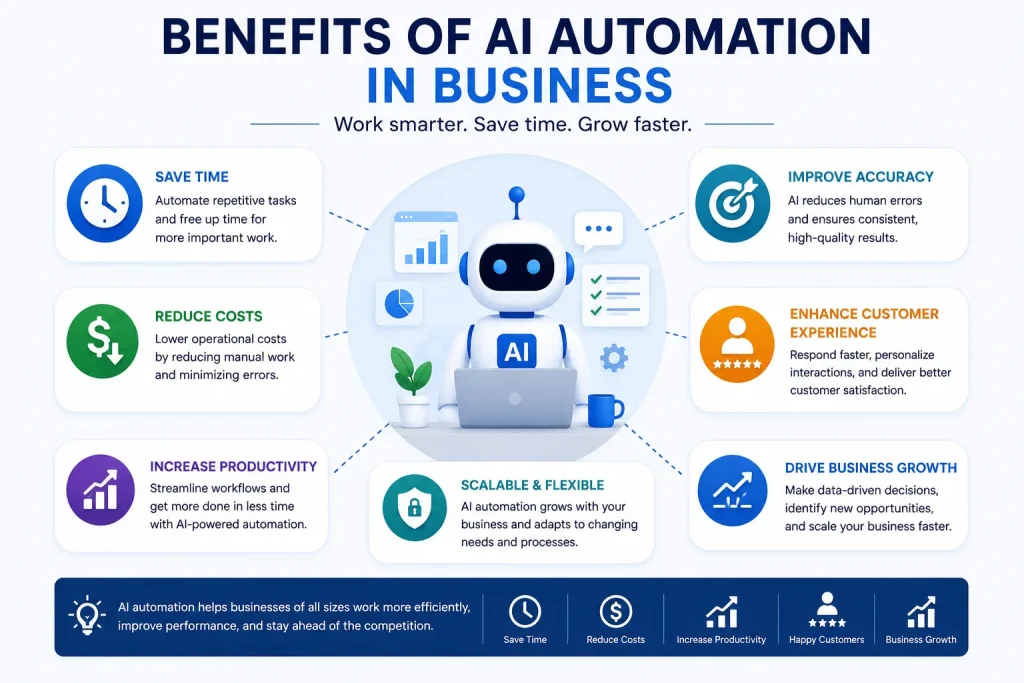
Improve Productivity.
Automated systems work continuously and consistently.
Consequently, businesses can accomplish more work without increasing workload.
Reduce Costs.
Manual processes often require additional resources and staff time.
In contrast, automation reduces operational costs while improving efficiency.
Improve Accuracy.
Human errors can create delays and expensive mistakes.
Fortunately, automated systems complete tasks consistently and accurately.
Enhance Customer Service.
Many organisations use AI-powered chatbots and support tools.
Therefore, customers receive faster responses and better service.
Common Uses of AI in Business.
Many businesses already use intelligent automation every day.
Customer Support.
AI chatbots can answer questions, provide information and assist customers around the clock.
As a result, businesses can improve support without increasing staffing costs.
Email Marketing.
Marketing teams use automation to personalise campaigns and improve engagement.
Furthermore, automated systems can optimise delivery times and customer targeting.
Lead Generation.
Automation tools help businesses identify and qualify potential customers.
Consequently, sales teams can focus on the opportunities most likely to convert.
Content Creation.
Many organisations use AI to assist with:
- Research
- Content planning
- Social media management
- Marketing campaigns
Therefore, teams can create content more efficiently.
Business Operations.
Companies also automate scheduling, invoicing, reporting and internal workflows.
As a result, operations become faster and more organised.
Why Most Businesses Struggle With Automation.
Although the benefits are clear, many businesses fail when implementing automation.
The problem is rarely the technology.
Instead, business owners often don’t know where to begin.
They may have dozens of repetitive tasks but struggle to identify which processes will deliver the biggest return on investment.
Others invest in multiple tools without creating a clear strategy.
Consequently, they waste time, money and effort.
This is one reason why structured implementation plans are so valuable. Understanding the concept is important, but knowing exactly what to automate and how to automate it is where real results begin.
Want a Practical AI Automation Plan?
Many people understand the theory behind automation. However, they struggle when it comes to implementation.
The AI Automation Blueprint was created specifically for entrepreneurs, freelancers and business owners who want practical guidance.
Instead of focusing on technical jargon, the guide outlines real-world automation opportunities, workflow examples and business applications that can help you save time and improve efficiency.
If you’re serious about implementing automation rather than simply learning about it, the blueprint provides a structured starting point.
Automation vs Traditional Workflows.
Many people assume automation simply replaces manual tasks.
However, modern systems offer much more.
Traditional workflows follow predefined instructions.
For example:
“If a customer submits a form, send an email.”
Intelligent systems can evaluate information before taking action.
For example:
“If a customer submits a form, analyse their interests, score the lead and send a personalised response.”
Therefore, businesses gain more value from every interaction.
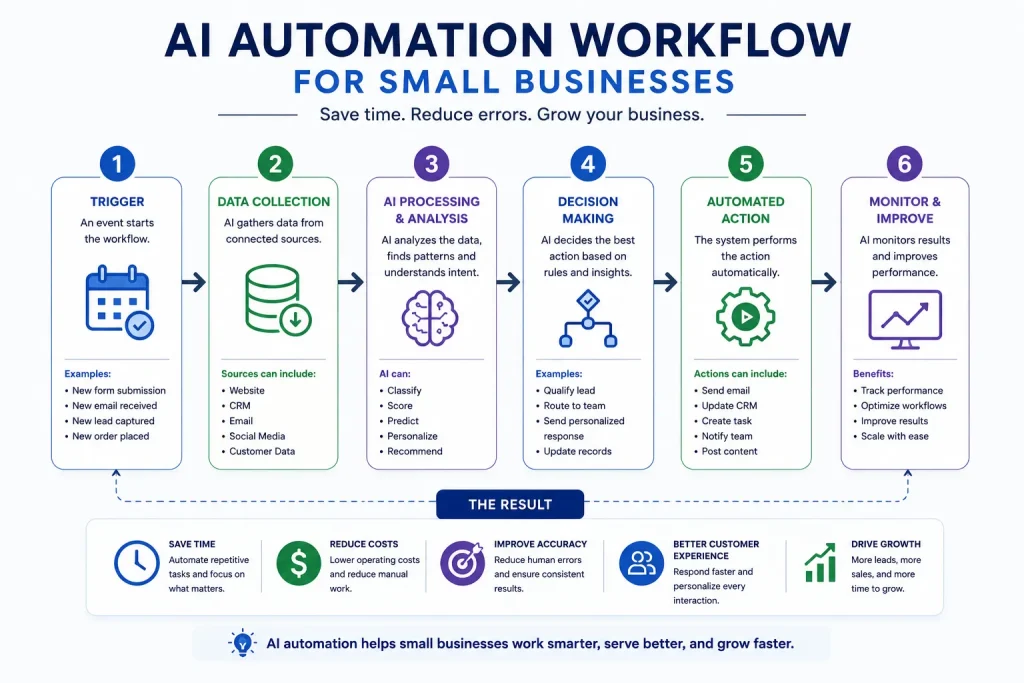
How Small Businesses Save Time With Automation.
Small businesses often have limited resources.
Consequently, efficiency becomes extremely important.
Automation can help by:
- Reducing administrative work
- Improving customer service
- Increasing productivity
- Managing leads
- Streamlining communication
Furthermore, many automation tools are now affordable and accessible.
As a result, small businesses can compete more effectively with larger organisations.
Business owners who want to build long-term systems often combine automation with operational frameworks. This approach helps create businesses that are more scalable, efficient and profitable over time.
Beyond Automation: Building a Complete AI Business.
Automation is often the first step.
However, the most successful entrepreneurs go further by integrating AI into multiple areas of their business.
This includes:
- Operations
- Marketing
- Customer support
- Lead generation
- Content creation
When these systems work together, businesses become significantly more efficient.
The AI Business Operating System explores how business owners can create connected systems that support growth while reducing manual workload.
For those who want to develop advanced AI skills, the AI Operator Blueprint provides practical guidance on managing AI-powered workflows and business processes effectively.
Common Mistakes to Avoid.
Although automation offers many benefits, beginners often make avoidable mistakes.
First, many people try to automate everything immediately.
Instead, start with one process and improve it before expanding.
Second, some businesses automate poor processes.
However, automation works best when the underlying workflow already functions effectively.
Finally, many owners fail to monitor performance.
Consequently, they miss opportunities to improve results.
Frequently Asked Questions.
What is AI automation in simple terms?
It is the use of artificial intelligence to automate tasks, analyse information and complete workflows with minimal human involvement.
Is automation only for large businesses?
No. Many modern tools are affordable and suitable for freelancers, entrepreneurs and small businesses.
What tasks can businesses automate?
Common examples include customer support, lead generation, email marketing, scheduling, reporting and content management.
Is AI automation difficult to learn?
Most modern platforms are beginner-friendly. Therefore, many people can start implementing simple workflows without technical experience.
Final Thoughts.
Understanding what is AI automation is the first step towards building a more efficient business.
These systems help organisations save time, reduce costs and improve productivity. Furthermore, they allow business owners to focus on growth instead of repetitive tasks.
However, understanding the concept and successfully implementing automation are two different things.
If you’re ready to move beyond theory and start building practical automation systems, the AI Automation Blueprint provides a step-by-step framework designed to help entrepreneurs and business owners put automation to work.
Inside the guide, you’ll discover proven automation opportunities, workflow examples and practical strategies that can help you create a smarter, more efficient business.
The future of business is becoming increasingly automated. The sooner you start learning these skills, the sooner you’ll begin seeing the benefits.